March 2026
Strait Closure Shockwaves & What Comes Next
The ongoing closure of the Strait of Hormuz has huge implications for investors.
It is a critical chokepoint for energy and trade. A disruption like what we are witnessing doesn’t stay local, it ripples through the world. Not only does it hit oil and LNG supply chains, but also global shipping routes.
Its closure will also have an impact on inflation and interest rate expectations. When supply tightens suddenly, markets react quickly, and often violently.
But I don’t need to tell you that, we’ve seen this unfold over the last few weeks.
Energy prices spike. Check. Been there, done that.
Oil and natural gas prices typically surge on supply fears, which is what we’ve witnessed. This benefits the oil majors, pipelines, midstream companies and LNG exporters. Many of these firms generate strong free cash flow during price spikes, reinforcing the safety of their dividend, and sometimes leading to special dividends or even share buybacks. All good things for the oil and gas investor.
But with the price spike, we’ll also see higher fuel costs for airlines, logistics companies, and manufactures (not to mention you and me). Higher fuel prices will impact everything in our economy. Expect to pay more as a consumer. But as an investors, think of how the higher fuel costs will impact a company’s bottom line. It may be worth considering how the companies you own in these areas will be impacted if the Strait of Hormuz is closed for a prolonged period of time.
Safety becomes a priority for every investor. When things become uncertain, investors move towards stability. So, what’s stable you might ask? Utilities, consumer staples, telecoms, banks. People have to keep their hydro on, buy food, do their banking, and no one is willing to give up their phones nowadays, whether we’re in a recession or not, those are the staples that will continue. As investors flood to these “safety” companies, their share prices rise. They become the popular stocks to own.
What Dividend Investors Should Look Out For
It’s time to carefully review your portfolio and if you’re interested in buying, watch out for those high yielding stocks, although tempting, it’s important to focus on sustainability. You want your portfolio to be there for you during tough times. If you are nervous about a company, check their free cash flow coverage, their debt levels and their exposure to commodity swings.
Energy stocks can be clear winners in a time like this, but look for companies with disciplined capital allocation that pay consistent dividends. Be wary of those that benefit from cyclical windfalls (I sold one recently, more on that later).
Market overreactions often create entry points. Look for high-quality dividend growers (growers being the key word here). They may dip temporarily, but if they are long-standing companies with a good balance sheet, they should be positioned well to withstand any fallout in the market.
Focus on:
Businesses that benefit from disruption
Companies that can pass through costs
Balance sheets that can withstand volatility
And as always, stay diversified as much as you can. The goal isn’t to predict every crash, it’s to build a portfolio that can endure them.
Our February Dividend Income
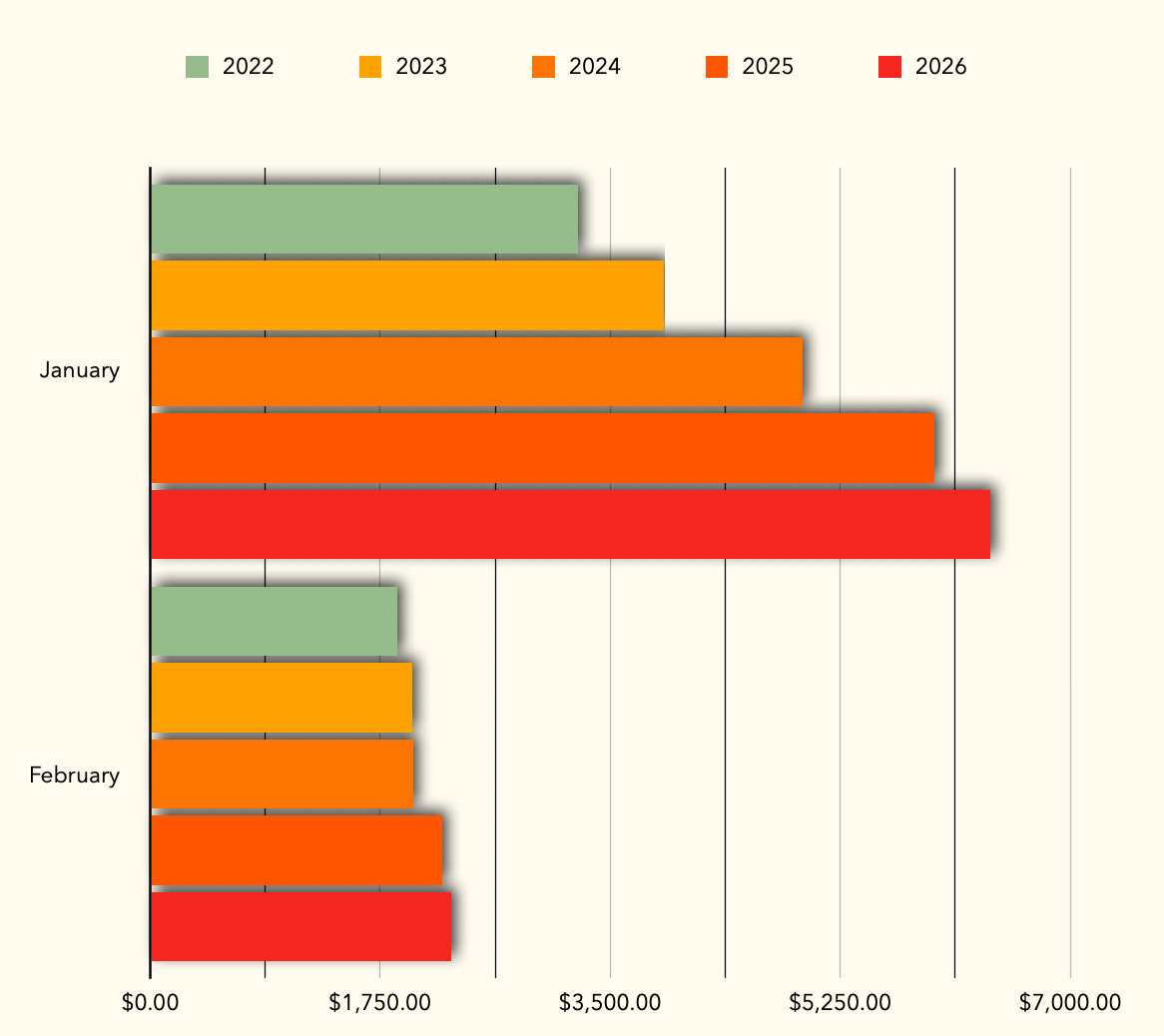
Our dividend income for the month of February came in at $2,300. A far cry from the amount we earned in January. Dividend income will fluctuate each month depending on the dividend payment schedule of the companies you own.
Here are the companies we own that paid us in February:
Bank of Montreal
Cardinal Energy
Dream Industrial REIT
Emera
Extendicare
Freehold Royalties
Northland Power
Peyto
Royal Bank
Slate Grocery REIT
Whitecap
Transactions
Be wary of those that benefit from cyclical windfalls (I sold one recently, more on that later).
With the escalation of tensions involving Iran, markets reacted exactly as you’d expect: fast, emotional, and heavily concentrated in energy. Even the threat of disruption to the Strait of Hormuz is enough to send crude prices sharply higher, which is exactly what we’ve seen reflected in West Texas Intermediate (WTI), now sitting at its highest levels in quite some time.
That surge created an opportunity, and I took it.
I decided to sell my position in Cardinal Energy. When I bought it in January, I fully expected volatility. That’s part of the deal with small-cap energy producers. They tend to amplify moves in oil prices, both up and down. I believed that oil would trend higher, but I’ll be honest, I didn’t expect it to happen this quickly or this aggressively.
When markets move that far, that fast, especially driven by geopolitics rather than fundamentals, I tend to treat it as a signal rather than a guarantee. So I exited while the momentum was strong. For me, that’s a win.
Now, my husband took a different approach. He’s more aggressive and is holding onto his shares of Cardinal Energy to see how this conflict unfolds. And to be fair, there’s a strong case for that. If tensions escalate further, oil prices could push even higher from here. I wouldn’t be surprised at all if that strategy pays off, but it comes with more risk, and I’m comfortable with the choice I made.
I also trimmed about one-third of my position in CES Energy Solutions. The stock has been on an incredible run, up roughly 280% for me, and is now trading around all-time highs. Rather than trying to squeeze every last dollar out of it, I chose to lock in some gains.
Importantly, I’m still holding the remaining shares. I continue to believe in the business and the broader tailwinds supporting energy services, especially in a higher-for-longer commodity environment. I’m happy to hold the remaining shares to see what happens.
We remain bullish on the energy sector and are still heavily invested, as it makes up more than 40% of our portfolio.
Don’t ever fret about taking gains, even if the stock continues higher after you sell. A gain is a gain. It’s real, it’s banked, and it moves your portfolio forward.
Every investor, without exception, has sold something too early. That’s just part of the process. What matters more is consistency: making thoughtful decisions, managing risk, and sticking to your strategy.
If you’ve locked in a win, that’s something worth recognizing. Take it, reset, and move on to the next opportunity.
That’s how portfolios grow over time, not by perfection, but by discipline.
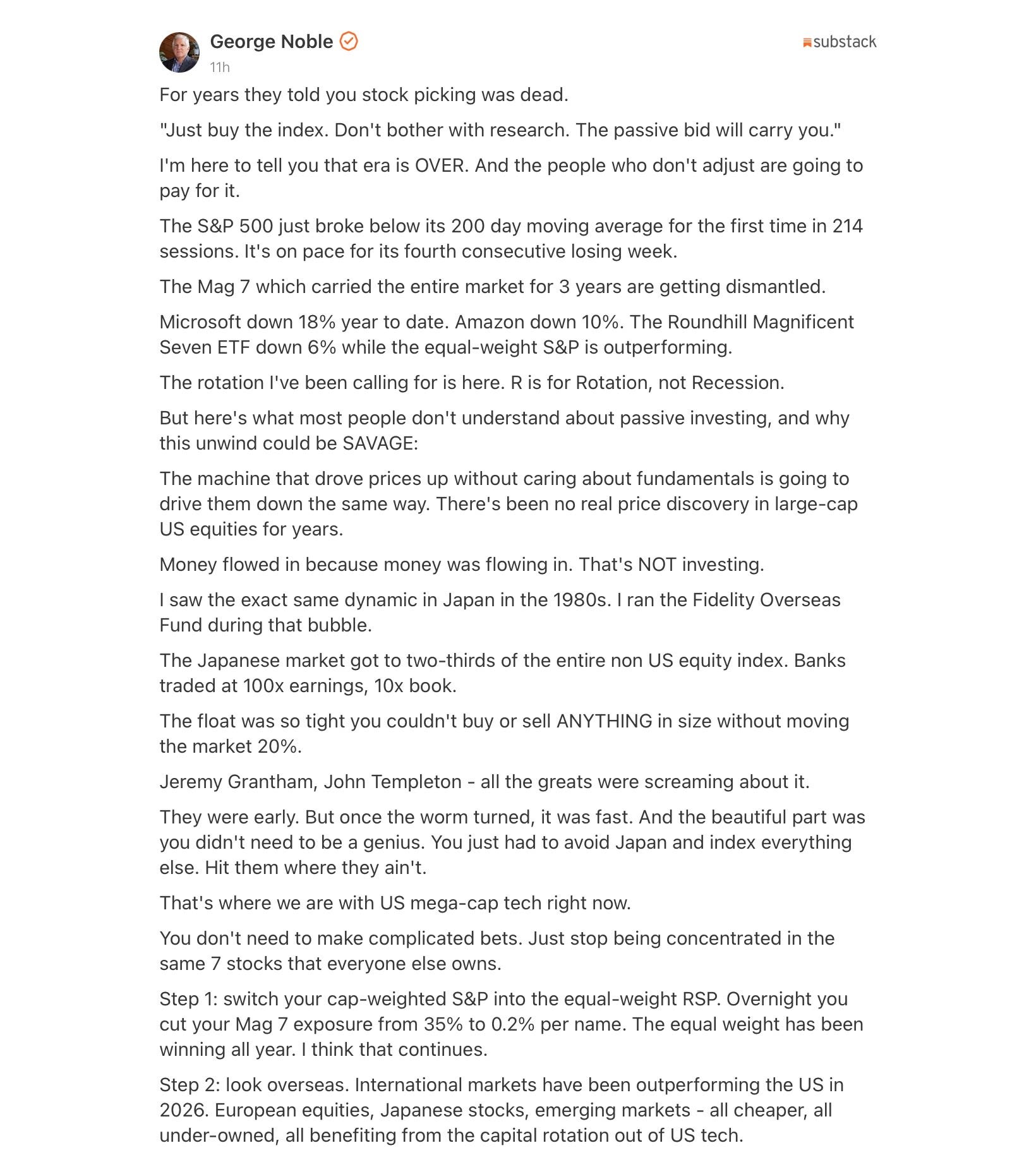
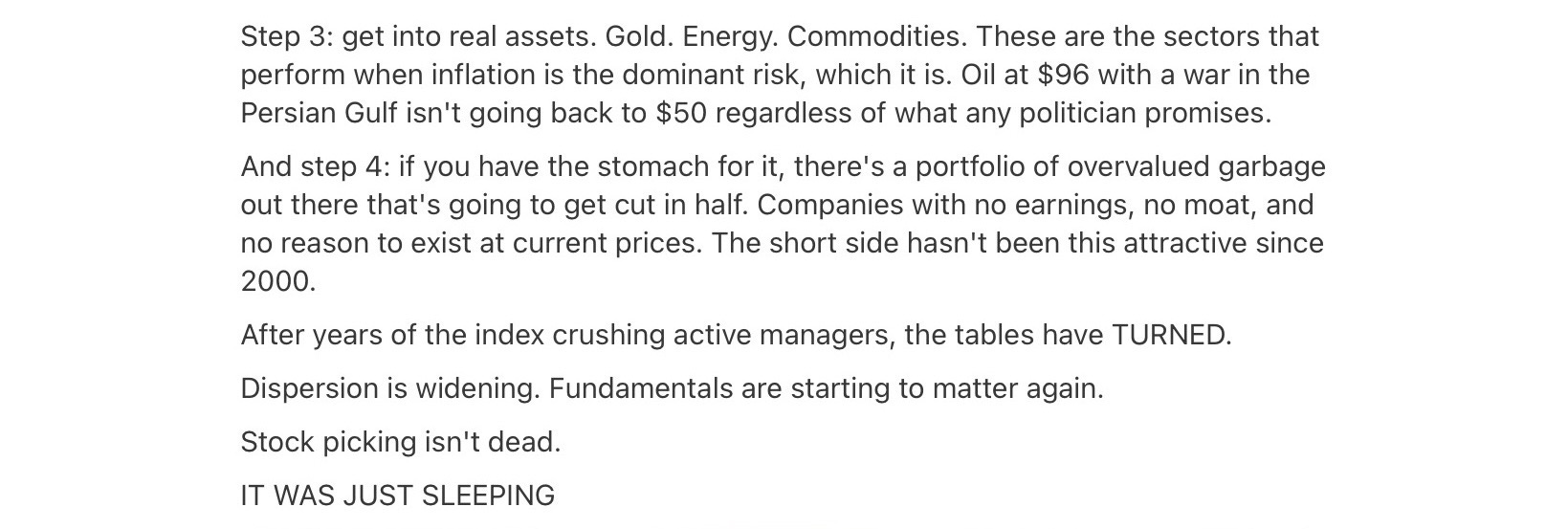
And on that note, I’ll leave you with a post I read yesterday.
As many of you know, I’ve never been an index fund investor. I’ve also been cautious about the U.S. market for some time, especially with the heavy concentration in the popular tech stocks that may not remain market favourites forever.
For those newer to investing, my advice is simple: be mindful of the risks. If you haven’t experienced a recession before it can be unsettling to watch stocks you believe in decline sharply. That’s when emotions take over and panic selling becomes a real temptation.
This is why conviction matters. It’s important to truly understand and believe in the companies you own so you can hold through volatility with confidence, knowing they have the strength to endure difficult periods and emerge stronger on the other side, especially during uncertain times like these.